LEARN THE FORMAT
Matrix reasoning: two worked examples
Practise finding a rule and building an answer. These are the two OMIB training examples used in our activity. Neither belongs to the 22 scored tasks.
A procedure to get started
- Describe what changes: bars, lines, positions or combinations.
- Propose a simple rule and check it against a completed row.
- Test it against the other row. If it fails, revise it before selecting elements.
- Apply the rule to the last row and check the entire combination.
Example 1: combine elements
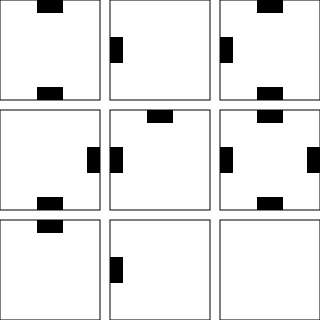
Look at the first two rows. What operation turns the first two figures into the third? Try stating a rule before opening the solution.
Show the answer and check the rule


Step by step
- First row: the first figure has top and bottom bars; the second adds a left bar. The third contains all three.
- Second row: combine the bottom and right bars with the top and left bars. All four positions appear, confirming the same rule.
- Last row: combine the top bar in the first cell with the left bar in the second. Do not add bottom or right bars.
- Build the answer using elements 9 and 10: the top and left bars. The complete combination, rather than either bar alone, is the solution.
Example 2: remove elements
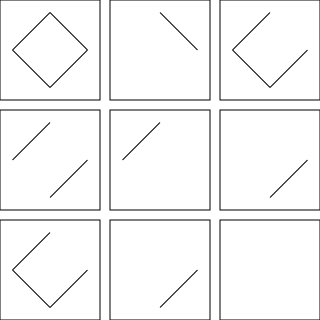
Simply combining every line does not work here. Look for what disappears between the first and third cells, and check what the middle cell contains.
Show the answer and check the rule

Step by step
- First row: start with all four sides of the diamond. Remove the upper-right diagonal shown in the second cell. The other three lines remain.
- Second row: the first figure contains the upper-left and lower-right diagonals. Remove the upper-left diagonal from the second cell; only the lower-right one remains.
- Last row: the first figure has three diagonals. The second shows the lower-right one. Removing it leaves the two lines on the left.
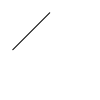
- Select elements 5 and 6: the upper-left and lower-left diagonals. Together they form an angle pointing left.
Check your explanation, not just your answer
Without looking at the steps, state each example’s rule in one sentence and explain how you checked it. If you remembered the elements but cannot justify the operation, work through the rows again. This is a check of your approach, rather than another score.
- Have I described an operation, rather than picked a shape that looks familiar?
- Does the same rule explain every cell in both completed rows?
- Have I checked position and orientation as well as the number of elements?
- Does my answer contain everything needed, with no additional elements?
- Can I explain why another combination fails without inventing an exception?
These examples demonstrate adding and removing elements. Do not assume that the same rule solves every matrix. No solutions are shown during the scored activity.